RV Solar Power Basics: Panels, Batteries, Controllers and Realistic Output
RV solar panels make electricity from sunlight, but they do not by themselves provide all the power a camper needs. A practical system usually includes a suitable solar charge controller, battery storage, electrical protection and sometimes an inverter for 120-volt appliances. Whether solar is worthwhile depends on how much electricity you use, where you park, and how reliably the system can recharge the battery.
This is a planning and comparison guide for trailers and motorhomes—not a wiring or installation tutorial. Existing RVs vary widely, and all component compatibility, circuit protection, grounding, roof mounting and installation work should follow the RV and equipment manuals and be checked by a qualified technician.
How an RV solar system works
Photovoltaic panels convert sunlight into direct-current (DC) electricity. The charge controller manages energy reaching the battery; the battery stores energy for use later. Many RV lights, fans and controls use DC, while a correctly specified inverter can supply alternating current (AC) for some household-style appliances. The US Department of Energy’s solar basics explain the photovoltaic principle; Victron’s RV electrical systems overview describes the components in an RV context.
| Component | Purpose | Question to ask |
|---|---|---|
| Solar panel(s) | Convert sunlight into DC electricity | Will the panels fit the space, weather exposure and travel style? |
| Charge controller | Regulates charging from the panels | Is it rated for the array and battery chemistry? |
| Battery bank | Stores energy for night and lower-sun periods | How much usable energy is available at the recommended operating limits? |
| Inverter (if needed) | Converts battery DC to AC for compatible loads | Which appliances require AC, and what do their specifications demand? |
| Protection and monitoring | Supports safe operation and tracks usage | Is the existing RV charging/protection configuration documented and compatible? |
Solar panel watts versus battery watt-hours
Watts (W) describe a rate of producing or using power. Watt-hours (Wh) describe energy accumulated or consumed over time. A panel marked 200 W has a rated output under defined test conditions; it does not generate 200 W for every hour of daylight.
As a hypothetical planning example, if a 200-watt array gets an equivalent of three full-rated sun hours, its gross theoretical energy is 200 × 3 = 600 Wh before controller, wiring, temperature, panel-angle, battery and other losses. Real production could be substantially lower. This is a demonstration of arithmetic, not a Vancouver or campground generation forecast. The Department of Energy’s system overview explains why mounting and system design affect production.
A refrigerator or furnace fan uses electricity according to its duty cycle and actual draw. A brief label reading is not enough to know daily energy demand. Ask an installer to use actual appliance specifications or measured energy usage to size the system, including overnight battery reserve and several lower-sun days where relevant.
Roof-mounted versus portable RV solar panels
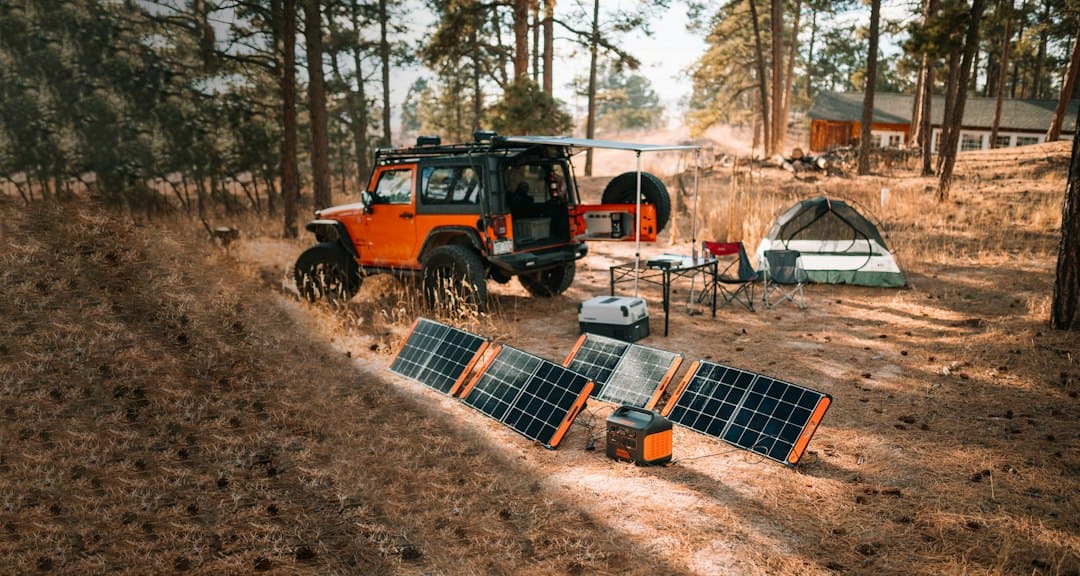
Illustrative photo: Jackery Power Station / Unsplash. Confirm equipment specifications with the relevant manufacturer.
Roof-mounted panels
Roof arrays stay on the RV while travelling and can recharge when exposed to sunlight without a separate setup at each stop. However, available roof space, rooftop shade, air conditioners, vents, roof structure, fasteners, water sealing and wind loads affect suitability. Never assume a mounting design is safe for your RV’s roof; professional assessment is especially important when an older trailer has prior water-damage repairs.
Portable solar panels
Portable panels can sometimes be positioned for sunlight while the RV stays shaded, which may suit short trips. They also require space, supervision, safe cable routing and secure storage; campground rules and the risk of theft or weather damage matter. Verify compatibility with the specific solar input or controller and the manufacturer’s instructions instead of assuming any portable panel can be connected directly to an RV battery.
What does the charge controller actually do?
A charge controller regulates the solar array’s energy so batteries are charged according to their intended limits. PWM and MPPT are two common approaches. MPPT controllers can harvest energy more effectively in many system designs, but the actual benefit depends on panel voltage, controller specifications, temperatures, wiring and load pattern. Neither type is automatically compatible with every battery chemistry.
Victron’s RV component guide and Renogy Canada’s RV solar overview explain why the controller and battery must be designed as a system. Product brands and technologies are given as sources of technical context, not as affiliate recommendations.
Will solar run a microwave, air conditioner or electric heater?
Not simply because the RV has panels. These are comparatively demanding loads, and some require a suitably rated inverter and substantial battery capacity. Their startup and continuous power demands must be checked against the actual equipment. A large solar array does not change the safe rating of your RV’s wiring or inverter. If consistent air-conditioning or electric cooking is essential, determine whether campsite shore power is a better match.
Our 30-amp versus 50-amp campground hookup guide compares the capacity of two common power services, and our full and partial hookup guide explains what campsite descriptions usually mean.
How does Canadian weather change solar expectations?
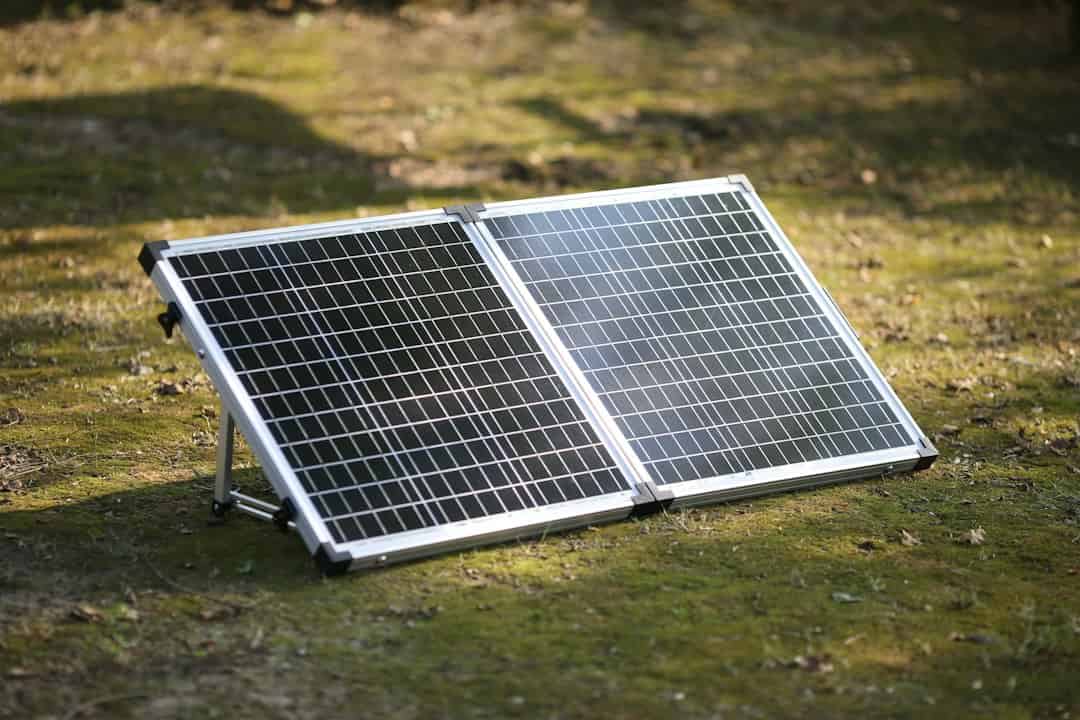
Illustrative photo: Newpowa / Unsplash. Confirm equipment specifications with the relevant manufacturer.
Winter days are shorter, the sun sits lower, and shade from tall trees or mountains can reduce output. Snow or debris blocking a panel may further reduce generation. Cold temperatures can affect panels and battery charging differently; a lithium battery might permit storage or discharge at temperatures where it does not permit charging. Never presume a solar controller will automatically protect every battery model during a freeze.
Our RV winter battery storage guide addresses AGM, flooded lead-acid and lithium limitations using individual manufacturer instructions. Systems used while camping are a different case from batteries left unattended in long-term storage.
What size solar setup should you consider?
Start with your camping habits rather than the largest advertised kit. For occasional powered campgrounds, solar may offer less incremental benefit than it does for frequent unserviced trips. Record which loads you actually use, for how long, and their real energy consumption. Ask a qualified installer to compare realistic daily energy demand with expected sunlight, usable battery capacity and the RV’s existing charging equipment.
- Short weekend trips: Think about overnight battery needs and whether you can recharge from another approved source.
- Unserviced campsites: Account for shade, season, several overcast days and charging restrictions.
- Mixed campground travel: Check compatibility with shore-power charging and any existing tow-vehicle charging system.
- Storage or winter use: Confirm what is allowed by the battery manufacturer when temperatures fall below its charging limit.
For related trip planning, see our weekend RV camping budget guide and water conservation when camping without hookups. Good energy planning should match actual travel needs, rather than adding hardware for a hypothetical setup.
Questions to ask before buying an RV solar kit
| Question | Why it matters |
|---|---|
| Which battery model and charger do I already have? | Solar charging must match approved battery chemistry and system settings |
| How much energy do my loads use each day? | Equipment sizing should follow demand, not marketing wattage alone |
| Will I camp in shade or in winter? | Actual sunlight may be far below panel test conditions |
| Does my RV have a solar prewire or an existing controller? | “Solar ready” does not necessarily mean a complete, compatible system |
| Can a qualified installer confirm safe mounting and protection? | Vehicle vibration, weatherproofing, wiring and electrical safety matter |
Frequently asked questions
Does an RV solar panel work on a cloudy day?
It may generate some electricity from available light, but production generally falls with reduced sunlight. Do not plan around a fixed percentage on a cloudy day without local evidence.
Do RV solar panels recharge at night?
No. Solar panels need light. Stored battery energy may power loads at night if the battery has adequate available capacity.
Can I connect a solar panel directly to my battery?
Do not assume that is safe. A compatible controller or manufacturer-approved interface is generally part of the RV system design. Ask the equipment manufacturer or qualified technician about your exact setup.
Is an inverter required for every RV solar system?
No. Many RV systems use battery DC for certain loads. An inverter is for appropriately designed AC loads, and it must be matched to the RV equipment.
Will a 200-watt panel always generate 600 Wh on a winter day?
No. The earlier 600 Wh figure is a hypothetical before-loss calculation based on an assumed three equivalent full-sun hours, not a prediction or guarantee.
References checked October 26, 2026
- US Department of Energy — Solar photovoltaic basics
- US Department of Energy — Solar PV system components and design
- Victron Energy — Understanding RV electrical components
- Renogy Canada — RV solar panels in Canada
Research-based educational guide: no solar component, RV roof, appliance or installation was independently tested. Manufacturers’ product ratings and sales claims are not endorsements. System design, installations and electrical safety checks belong to qualified professionals.